Verified from the available record
- The equipment image is published in the Zarts air duct cleaning gallery.
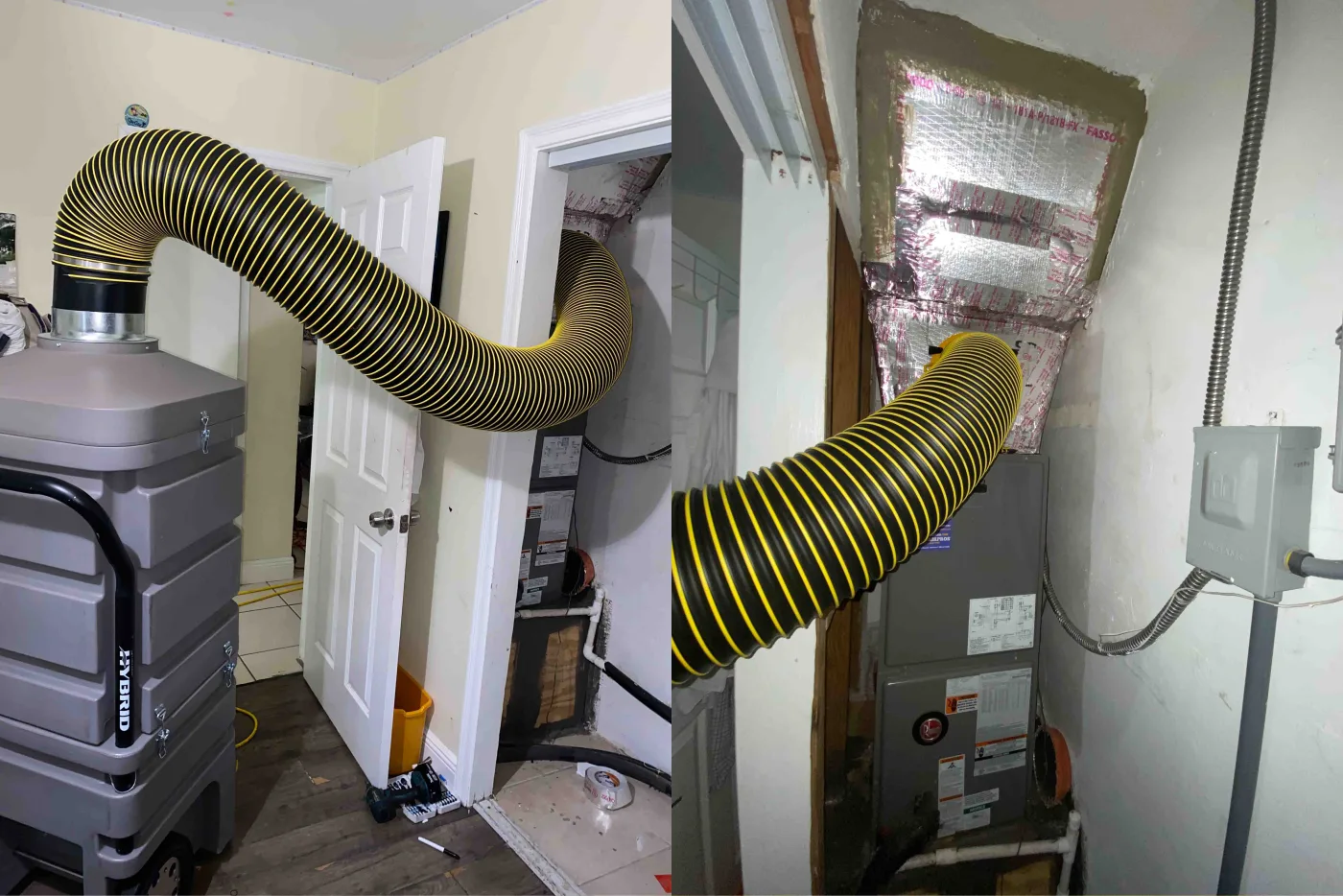
- One large collection hose is visibly connected between the portable unit and a sealed duct access opening above the indoor air handler.
- Zarts identifies the pictured collection equipment as a HyperVAC negative-pressure vacuum setup.
Not established by this record
- Customer, property, city, date, HVAC-system type, and job identifier
- The pressure or airflow achieved during this particular setup
- The agitation tools, sequence, duration, and final condition for this specific visit
What negative-pressure collection is intended to do
During duct cleaning, agitation loosens material from accessible interior surfaces. A collection system is used to capture displaced debris rather than allowing it to move freely into occupied rooms. The U.S. Environmental Protection Agency advises that service providers using vacuum collection equipment exhausted inside a home should use high-efficiency particle filtration.
The photo shows the collection side of the setup, but it cannot show suction throughout every branch or prove that every component was included. Connection location, system isolation, access openings, duct layout, air leakage, and the sequence of work all affect the service.
Equipment specifications are not the whole scope
Zarts describes its standard equipment as a portable negative-pressure vacuum with three-stage filtration and final-stage HEPA filtration, paired with 180–200 PSI compressed-air tools. Those details help homeowners understand the available method. They should not be used to claim that the exact pressure was applied everywhere or that the image alone verifies the complete procedure for this photographed visit.
A useful proposal explains the components to be cleaned, how registers and grilles are handled, where the vacuum will connect, how material will be loosened, how the work area will be protected, and what limitations may remain. A recognizable machine does not substitute for that explanation.
Why this remains an equipment field note
To publish this as a complete project case study, the equipment photo would need to be tied to a work record with the service date, approved location, property type, system layout, observed conditions, completed scope, and outcome documentation. Any customer quote would need its correct source, exact wording or a clearly identified excerpt, and publication permission where required.
Keeping this record at the equipment-note level strengthens trust. It shows a genuine Zarts setup, explains the role of debris capture, and states exactly where the available evidence stops.
Evidence and editorial standard
Zarts uses genuine service images, component-specific descriptions, and documented service procedures. A full case study is published only when the job record supports the property context, observed condition, completed scope, method, result, photo relationship, and any customer quote or permission. Images are not assigned to a city without a supporting service record.