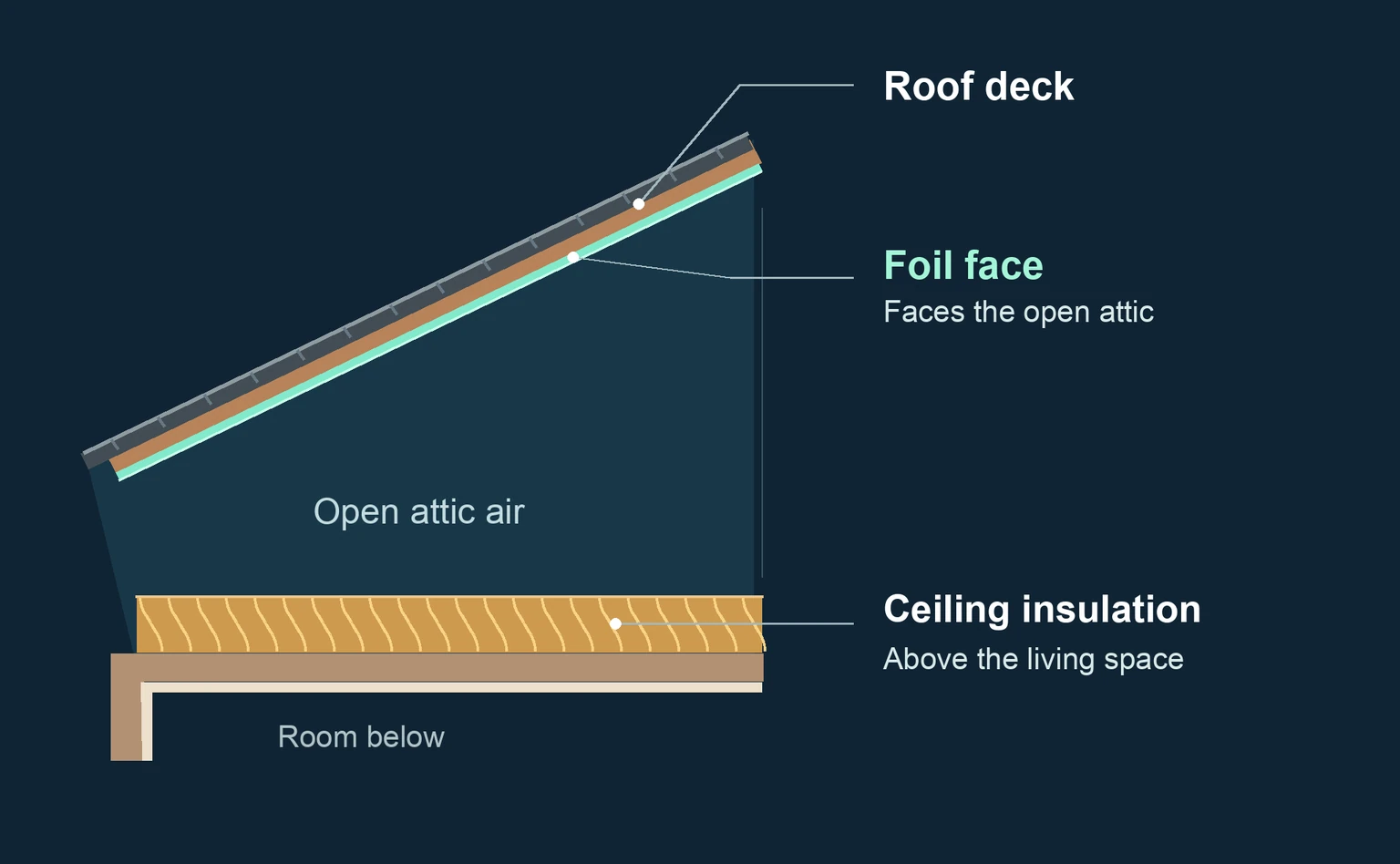
If one bedroom stays warm late in the day, start with two questions. What sits above its ceiling? How does cooled air reach the room? A sun-exposed attic, a gap in the insulation, and a damaged supply duct can each affect comfort. A sketch of the roof, ceiling insulation, and duct route gives you a way to compare proposals for that room.
Why the air space matters
On a sunny afternoon, the roof covering warms the deck beneath it. The underside of the deck gives off infrared energy. Surfaces in its line of sight, including the top of the ceiling insulation, absorb some of that energy. Exposed aluminum foil has low emissivity, which means it gives off relatively little infrared energy toward those surfaces at the same temperature.
Picture two installations. In the first, foil is bonded to the underside of the roof deck and its shiny face looks into the attic. In the second, the shiny face is pressed against another solid layer. Only the first has an air space at the working face. A drawing that shows which side faces open air tells you more about the design than a sample of shiny material.
What the Florida field study measured
Florida Solar Energy Center researchers installed barriers in nine Central Florida homes in 2000. They compared summer cooling use in eight homes after matching periods with similar outdoor temperatures. The final home had too little summer data after installation. Across the eight homes, cooling electricity use fell by an average of about 3.6 kilowatt-hours per day, or roughly 9 percent.
The study measured electricity for cooling. A household bill also includes water heating, lighting, appliances, and other uses. A claim that applies the study percentage to your entire bill uses a different starting point. The homes had shingle roofs and attic ducts, and individual results varied. Ask how closely your roof exposure, duct location, insulation, and thermostat schedule resemble the assumptions behind a savings estimate.
Roof foil, ceiling insulation, or duct repair?
Ceiling insulation slows heat moving into the rooms below. Where insulation is thin or missing in patches, ask for a price to restore even coverage. A ceiling hatch or an opening around pipes can also let air move between the home and attic. An energy assessment can identify those openings while the ceiling is still accessible for sealing.
R-value describes resistance to heat flow. A label on a roll of fiberglass gives the value for a specified thickness. For a reflective insulation system, the tested air space can contribute to the advertised rating. Ask the bidder to show how the spacing and orientation in the test compare with the space available in your attic.
Ducts pose a different question. If cool air escapes from a supply connection, it goes straight into the attic. If the duct jacket is damaged, the moving air can pick up heat along its route. For a single room with weak airflow, ask an HVAC professional to check the branch, its connections, and its insulation. A foil proposal addresses the heat radiated across the attic.
Compare a reroof with a retrofit
When a roofer already plans to replace the deck, ask for the added price of sheathing with a factory-applied foil face. For an existing roof that will stay in place, a contractor can assess whether a sheet can be fitted along the rafters. Labor and access can make the price quite different even when the two proposals cover the same roof area.
For a vented attic, ask the installer to mark the ventilation openings on the drawing and show how they will stay clear. Foil laid flat over attic-floor insulation can collect dust on its upper surface and can trap moisture beneath it. Damp insulation or roof leaks deserve attention before an upgrade. A sealed attic with insulation at the roofline needs a separate assessment of that roof assembly.
How to compare two written quotes
Ask each bidder for the installed price, the expected annual cooling savings in kilowatt-hours, and the electricity rate used to convert those savings into dollars. Then divide the installed price by the estimated yearly dollar savings for a simple payback. For example, a hypothetical $900 upgrade saving $60 per year would take 15 years to recover its cost at that rate. Substitute your own quote and a house-specific estimate.
- Request a drawing of the foil face, adjacent air space, and existing insulation.
- If the estimate quotes an R-value, ask which complete assembly and air space were tested.
- Ask for a separate price for any air sealing, duct repair, or insulation work so you can compare the options independently.
Have a question about dust inside your ducts?
For duct cleaning, share a photo of the visible buildup and tell Zarts which rooms the system serves. For a radiant barrier quote, ask a roofer or insulation contractor to evaluate your attic.
Sources and further reading
These primary sources support the general consumer and system information in this guide. They do not endorse Zarts or replace evaluation of a specific home.